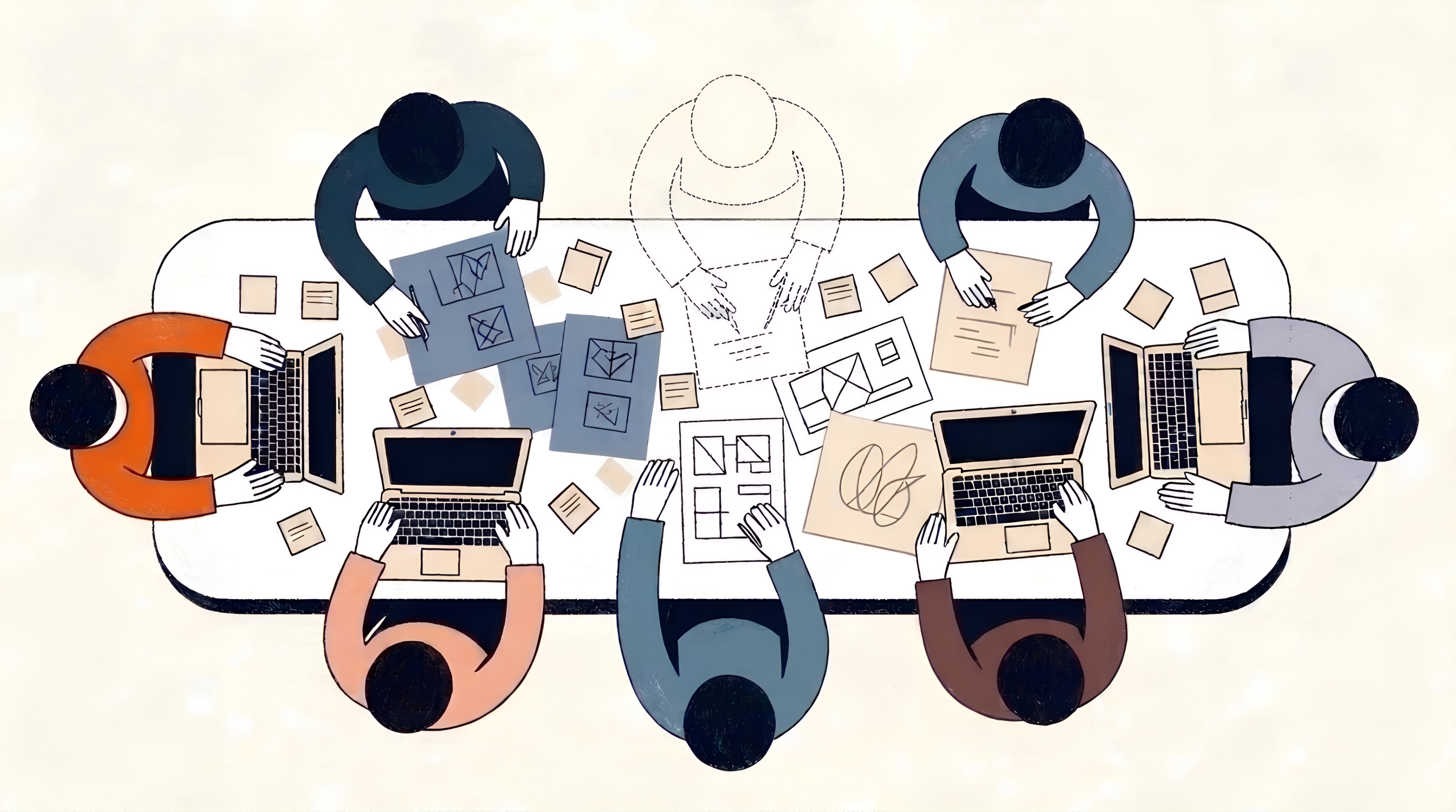
Last week the design executive recruiter Tom Scott published an interview with Pedro Marques about running a design org in 2026. Near the end, Marques shares the question he likes to ask design leaders when they walk him through their team’s work:
What in this work would have been different if you weren’t there?
I think that question gets at why leaders should exist in the first place.
I’ve spent the days since running it against my own year. A little over a year ago I joined Mural to lead design. Since then the company has been reinventing its product for an agentic era, the design team has been learning to work in a completely different medium, and the org itself has been rebuilt while both of those things were underway. Three transformations, stacked in an action-packed year.
So what would have been different if I weren’t there?
I can’t point to a flow and say that one’s mine, and I don’t think I should be able to. My answer is the conditions the work got made in. A head of design exists to create the right conditions for good design to happen.
2026 was the year that stopped being a nice platitude and became THE job description.
Same profession, different job
My first gig was at an agency in the early 2000s, working on the Logitech website and Apple in-store demos. Almost two decades later, in 2025, I was at Roblox, working on the Roblox Economy and later on social and community products.
The designs I worked on could hardly have been more different, yet the design process and the tools between the agency work and the gaming platform roles were largely the same. And that’s been the case across the span of my career. It was the same at the company before Roblox, and the company before that…
The design culture at Roblox set a very high bar for craft, and I learned a lot from it. The design org’s emphasis was on consistency across an enormous platform. In practice, that meant close attention to spacing and color usage, immaculate Figma files, and polished, standardized slide decks. At that scale, consistency is a real thing to care about. It was also where most of the org’s attention went, which left less room for conversations about core interactions and overall design strategy.
Everything changed in 2026.
In the span of a few months, our jobs were completely overhauled. We now spend practically as much time talking to machines as we do talking to people. We push more code than pixels.
My primary artifact is a working prototype, and its job is to carry a conversation with senior executives. My design reviews are walkthroughs of running software. The design system our team maintains is being rebuilt so that an agent can read it as easily as a designer can. And the most valuable alignment tool I own is a URL.
After almost two decades of the same process, suddenly almost nothing about the two jobs is the same.
I’m obviously not unique here. Designer Fund surveyed more than 900 designers this spring and found weekly AI use had jumped from 54% to 91% in a year. Half of them had shipped AI-generated code to production. Figma’s 2026 AI report found the share of designers participating in development had nearly doubled, from 21% to 41%. And when UX Tools ran its State of Prototyping survey, the founder Tommy Geoco summed up the result in a line that’s worth pondering:
An AI coding terminal is now more embedded in designer workflows than any canvas-first tool.
I spent 2025 in Figma, obsessing over the pixels my team had manually placed on the screen. Even though I had tried building things with AI, the tools and models still weren’t solid enough to take seriously. That quote would have sounded absurd to me then.
The same Designer Fund survey has a number I find more interesting than any of the adoption stats. Seventy-three percent of designers feel expectations are rising. Yet, only 28% of leaders say they’ve formally updated how they evaluate, pay, or hire.
That gap is the working conditions problem, expressed as a stat. The work changed. The environment around the work mostly didn’t.
The three rooms
When I look at where my year actually went, it sorts into three rooms. The room where leadership decides what the company will be. The room where the team makes the work. And the customer’s room, where the work has to survive contact with real people.
My job is to make sure good design can happen in each of the three rooms, and to carry what I learn in one room into the other two.
Marques’s question works in all three.
Room one: with leadership
In May I spent a stretch of weeks working almost daily with our CEO on one question: what does our product become when agents can do much of the work? I’ve written about the mechanics of that in my last post. The short version is that we went through ten to twelve coded iterations of a prototype. I reviewed branches with our CPO and CTO, then sat down with the CEO the next day to continue the conversation from wherever the prototype had moved it.
What I didn’t say in that earlier article is why this mattered beyond speed.
A C-Suite in a transformation moment holds a vision that moves faster than anyone can document. Every function in the company is trying to read that vision and translate it into their own plans. In my experience, the translations drift. You end up with several strategy documents that each sound right and don’t quite agree with one another. Each team moves in a slightly different direction on their small slice, with a limited understanding of the broader strategic space.
The new problem every product leader is dealing with is rapid alignment at scale. Luckily, designers bring a tool to the table that does half the job:
A prototype that doesn’t drift. It’s one object, everyone clicks the same thing, and disagreement becomes specific. You stop arguing about what “agentic” means and start arguing about whether this agent should have acted here in this way.
That’s the condition I can create in room one: a shared, concrete thing to react to. If I weren’t there, I suspect the company would still have found its direction. It would have taken longer, and the direction would have lived in prose.
Marques makes a point about this room that every design leader should memorize. Before taking a head of design job, he says, ask what you’ll be accountable for and what power you’ll be given to deliver it.
Accountability without power turns the role into politics.
I’d add a corollary from this year. In a company that’s reinventing itself, the power worth having is proximity to the question. Headcount and reporting lines matter less than they used to. The person who can make the CEO’s idea tangible by tomorrow morning gets invited back the morning after.
Room two: with the team
This was the hardest room of the three.
Asking a team to change its medium while the company changes its strategy is a lot. I came in with a long list and a great deal of energy, and early on I got direct feedback that I was doing too much at once. It was correct. I narrowed my focus, and I’ve tried since to be clearer about what’s fixed and what’s flexible. If I could send one note back to myself from last fall, it would say two contradictory things: move faster on the decisions, and slower on the people.
The team already had plenty of ideas, mine included. What they needed from me was conditions. Here’s what I built, in rough order.
Permission, stated out loud
Designers needed to hear that they were allowed to challenge old product decisions and to own a problem end to end, without waiting for a ticket. You’d be surprised how much good design is waiting on someone senior to say go ahead, do it.
A new medium, taught hands-on
In February we ran an optional working session for about half the product org on Claude Code, Cursor, and a starter prototyping repo. We now hold a regular AI skillshare, and every Monday standup includes one thing each person discovered that week.
Three review gates
A problem alignment review before design starts. A prototype-led crit in the middle. A craft readiness review before engineering builds. Our crits used to be silent sticky-note sessions on a static frame, which assumed the problem, the core designs, and the questions were right in the first place. Now designers walk the room through a working prototype with a running flow. Prototypes lay bare the truth that individual screens hide.
Crits at Mural used to be a closed room. Figuratively, there was a sign on the clubhouse door: Designers Only. It felt sensible until I noticed what happened inside. Designers talking to designers share the same history, repeat the same assumptions, and miss the same blind spots, so the feedback never got any wider than the room. Now crits are open. Anyone on the team can join, including people from consulting, marketing, product management, and engineering, because they see problems that designers miss.
Levels that describe the real job
I rewrote our leveling framework this year to spell out the gig at every level. The heuristics now include AI skills explicitly, including designing for agents, alongside the fundamentals that haven’t changed.
A hiring bar to match
AI fluency became a hard requirement for senior hires. Only about a third of the candidates I met this year cleared it.
Go slow to go fast
The review gates deserve a defense, because they sound like the opposite of speed. When everyone can produce a plausible prototype by lunch, the scarce thing is the judgment to know which one is right. The gates are where that judgment gets exercised in public.
My line to the team is slow down the thinking to go faster in execution, and I believe rigor is what makes principled risk-taking possible.
Jen Dunnam, who leads design futures at Hinge, described her version of this to Figma’s blog this summer:
I’ve found my job is more to steady things.
I felt that one. In a year when every tool, every title, and every org chart is in motion, a team doesn’t need its leader to add urgency. There’s plenty already. It needs someone to say which kind of speed matters this week, and to hold the bar still while everything else moves.
One more stat from the Designer Fund survey has stayed with me. The share of designers who say AI has decreased their collaboration went from 5% to 20% in a year. Everyone has a tireless partner in their terminal now, and it’s easy to stop turning to colleagues for one-on-one guidance.
I work at a collaboration company, so I may be biased. But I think this is the underrated risk of an AI-native design and product team. Standups, crits, skillshares, and reviews used to be overhead. Now they’re the only place the team’s taste gets shared.
Room three: with customers
One day, our CEO called me with a message she wanted the design team to hear. I’ll paraphrase: she is one person, she is not our target audience, and nothing we were prototyping together counted until real users had been in front of it.
I love that she said it, because room one has a failure mode. Prototyping with an executive is intoxicating. The feedback is fast, the stakes feel high, and it is very easy to mistake a delighted leader for a validated product.
So we work in short validation cycles: a hypothesis, a coded prototype, a test with real people, and a decision, all inside about two weeks. One of those cycles killed a feature idea we’d been attached to for a long time.
A few surveys with a few thousand people also shook free long-held institutional beliefs. In retrospect, this bad news is good, even though it didn’t feel like it on the days the results were shared.
The other thing room three gave me this year was a view into our customers’ own transformations. Our CEO came back from a listening tour and told me that one of the most engaged people she met was a head of design, who was already prototyping agents with their own teams. This was early in the year, and this design leader was a more sophisticated AI user than all the other executives in that room.
That’s worth pausing on. Inside large, traditional companies, the design leader is becoming the person who understands how humans and AI will work together, because they’ve been building it with their own hands. Nobody had to make the case for design’s seat. It’s being earned in practice, daily through curious personal experimentation, which I think is an essential attribute of the best AI-native design leaders.
So what’s still defensible?
Now for the market, because none of this happens in a vacuum.
In early February, a Jefferies trader named Jeffrey Favuzza gave the software sell-off its name: the SaaSpocalypse. By Forrester’s count, more than a trillion dollars of software market value disappeared in the first week of that month. The fear was simple. If agents can do the work of many seats, and if customers can build their own tools, what exactly is a software company selling?
A week later a developer named Martin Alderson published a post called “Attack of the Clones,” and it’s the most useful thing I read all year on the subject:
I cloned most of Linear’s core functionality in 20 prompts using Claude Code.
Two evenings. A two-hundred-dollar subscription.
In September, Brandon Thomas vibe coded a replacement for the entire Adobe suite, and released it for free. He launched the open-source project out of frustration with Adobe’s subscription model and cancellation fees.
And as I write this in late November, AI stocks are sliding, and Nvidia’s leadership crisis is part of why the drop looks so sharp. But the damage didn’t start with Nvidia. Hedge funds had crowded into AI stocks, and as they pulled back, the whole group fell with them.
The real question is whether investors have lost faith in the technology, whether circular financing is unravelling at an Enron-like scale, or whether traders are simply leaving a crowded room?
SaaSpocalypse!
Reverse engineering!
The AI math ain’t mathin’!
2026. The year of Fear and Doubt?
I think the panic is overdone in the short term. Ramp’s economist looked at actual spending across more than 200 vendors in April and found seat-based contracts still made up roughly two-thirds to three-quarters of software spend, barely changed from a year earlier. Companies aren’t ripping out their tools.
But the direction is real, and it shapes the question every product team should be asking. When the features can be copied in a weekend, what’s left?
The popular answer in design circles is taste. I don’t fully buy it, and neither do the sharper skeptics. Shrivu Shankar’s essay “Taste Is Not a Moat” argues that taste is a decaying advantage measured against a model baseline that keeps rising. A piece from a16z this summer made a related point: the scarce thing is the institutions and apprenticeships that train judgment.
I think that second argument is on track, and it’s the work conditions argument again. A single designer’s taste can be imitated. A company’s collective habit of noticing what matters to people is much harder to copy, because it lives in review gates, in who gets invited to the room, in what the C-Suite asks about.
Here’s the kind of thing I mean. Earlier this year we were designing a usage limit for our free plan. On paper, it was a clean rule. Then, in review, we walked the scenario forward: a host hits the limit in the middle of a live session, and the board locks in front of everyone they invited.
The rule was fine.
The moment was humiliating.
We added a grace period.
Design pushed for this, because we’ve trained each other to think through journeys critically, and with empathy.
No cloner picks that up from code munging. It isn’t in the feature list. Alice Moore at Builder.io put it well in October:
Copying software is cheap now. Making it good isn’t.
That’s what I mean by the human element: the accumulated evidence, across a thousand small decisions, that someone at this company imagined your afternoon and cared how it went.
The products that embrace the human element are, I believe, the products that will win in 2027 and beyond.
And that is why design’s line to the C-suite matters more now than it did when I was reviewing pixels. Those thousand small decisions cost time. Somebody has to make the case, in the room where tradeoffs get made, that the grace period is the product. If design isn’t in that room with something concrete in hand, the case doesn’t get made.
What I’m watching for in 2027
Five opinions, held loosely.
Design teams get smaller, and the bar gets higher
Earlier I cited the Designer Fund finding that 73% of designers feel expectations rising while only 28% of leaders have formally changed how they evaluate, pay, or hire. I don’t think that gap survives 2027. Designers who have rebuilt their craft around a new medium will go where the leveling and the pay describe the job they actually do. Leveling is where I started, because it’s the piece a design leader can change without waiting for anyone else.
Our new heuristics paid off, and the value was immediately apparent with our recent hires. Orgs will start paying for these gems. High-craft, proactive, curious, AI-native designers are going to have multiple job offers. Everyone else will have #opentowork badges.
The second half of this bet is about size. I’ve said internally that I want us operating at the level of the best product companies in the world, and part of how we get there is hiring only people who have already worked at a high level of rigor. This year I turned down way more candidates than I advanced.
I expect that to become normal, as designers reskill. Marques describes design orgs that are already much smaller and more generalist than they were two years ago, and Figma’s hiring research found 56% of hiring managers see rising demand for senior designers against 25% for juniors. Smaller teams of more capable people, each covering more ground.
That worries me for people entering the field, and I don’t have a good answer for it yet.
A leader who isn’t building with AI can’t review the work
“Hands-on” has become a design leadership recruiting cliché, so let me be specific about why it matters. When a designer on my team shows me an agentic flow, the screens are the least of it. Most of the design is under the hood. I’ve described it to peers as closer to service design: you’re designing an orchestration layer, and a computer executes it where a team of humans used to. For that reason, I ran a bootcamp on writing evals this year. If a system generates output distributed across a range, somebody has to design the range.
A leader who hasn’t done that work personally can’t give useful feedback to the people who are doing it. They’ll critique the surface, because the surface is all they know how to see. One example from a crit this summer: a designer was using our product’s MCP server to generate a first pass, then fixing the resulting output by hand.
I asked them to try making every change through the agent, even though it was slow and clumsy, because the friction would show them which design patterns the product was missing. That isn’t advice you can give from a slide. You have to have felt the friction yourself.
Marques makes a similar argument about technical depth: if you lead design on an AI product, you need to understand how evals and model behavior work, the same way a graphic designer understands paper.
The design system becomes infrastructure for agents
We built an MCP server for our design system this year, and we’re now encoding our design practices as skills that sit on top of it. I have a list of about twenty we are writing, covering the whole process from competitive research to evaluating a finished flow. The goal is a system that can check a prototype against our standards before a human ever looks at it, which cuts down on the variance that shows up when ten people are generating UI at once. I wrote about the reasoning behind this a couple of weeks ago.
I’d bet this is table stakes by the end of 2027. Figma used Config this year to introduce skills that package a team’s conventions as reusable instructions for its agent, which tells you where the tool makers think this is headed. The harder part is ownership. We lost a genuinely useful internal tool this year because the person who built it moved on and nobody picked it up. Machine-readable design infrastructure needs an owner and a budget, the same as the component library did a decade ago.
Collaboration has to be designed back in
In the Designer Fund survey, one in five designers now says AI has reduced how much they collaborate. A year earlier, it was one in twenty. I’d repeat this stat in every design org, because it describes a failure that looks like productivity… while it’s slowly degrading your org.
I see the early version of it in crit. Someone asks an agent for eight variations and brings all eight, without having decided which one is right or why. The volume is impressive, but the judgment is missing. The human value in our work was never the pixel pushing. It’s understanding the problem, and that understanding gets sharper when people argue about it together. Roles are blurring at the same time: Figma’s AI report found 41% of teams say AI has meaningfully changed how they work together, up from 7% two years ago. I want PMs and engineers prototyping, and I want my designers shipping code and writing product briefs. But when everyone can produce alone, the team has to be deliberate about deciding together. That’s a ritual design problem, and it belongs to the leader.
The pessimists are partly right
Figma’s State of the Designer survey found designers split almost evenly on whether the field is getting better or worse. I don’t think the worried third is wrong. When a former colleague asked me last week what I’m most anxious about, my answer had nothing to do with design tools. It was how fast the software business itself is changing underneath all of us. Andy Budd laid out the bear case for design well in Smashing Magazine this summer:
Autonomy has teeth. If AI gives designers more room to act, it also removes some of the cover.
He’s right about the cover. For years, a design team could point to process, headcount, and volume of output as evidence of its value. Those are gone, or going. What’s left is whether the product is better because we were in the room, and whether the people who run the company can see that it is.
That’s a harder test than the one we used to face. I also think it’s the better one, and it leads to my hottest take that underpins these five.
Design is becoming strategic again
Read Budd’s line a second time. If production no longer gives design its cover, it no longer takes up design’s time either.
You can see what designers are doing with that time in the data. In the Designer Fund survey, 65% of designers say they’re taking on more product or engineering responsibilities, and 40% say PMs and engineers are contributing more to design. Figma’s head of insights wrote in March that AI is “dissolving product development swimlanes”: PMs are prototyping, engineers are designing, and designers are moving into higher-order strategic work.
The best designers are already working in a dual role, part designer and part strategic product lead. With the production side of design largely automated, there is far more room to be a big thinker, and to dust off those influence skills. These designers build out a cohesive vision for the product, and then they break it down into chunks a team can actually ship, and they do it in a handful of weeks.
Designers also bring something to that role that’s easy to undervalue: alignment. Design thinking methods are tools for getting a group of people with different incentives to look at the same problem and agree on what it is. Our LUMA practice at Mural is built around exactly this. Put that together with rapid prototyping and a real understanding of users through research, and you have a discipline that can take a complex problem and turn it into a simple conversation.
That puts design in a position to steer the product, and the executive conversation along with it.
It’s what happened in room one this year. The prototype got us into the conversation. Research and facilitation are what made the conversation go somewhere.
There’s a condition attached. The same survey asked design leaders what they’re hiring for, and after AI fluency, the top answers were systems thinking and strategic skills. Only 5% said they’re placing less emphasis on execution quality. Nobody is lowering the bar on craft. They’re assuming it.
So if craft and production have to become table stakes that a team can automate, designers better bring more to the table than a pixel-perfect portfolio. It gets you in the door, but in 2027 your big-picture thinking and judgment will get you the gig.
The consistency I spent 2025 checking by eye — the spacing and the color usage — this is what an agent-readable design system should now guarantee. When it does, the hours go to the questions I wanted more room for back then: the core interactions, and the strategy that satisfies both people problems and business problems.
Design gets to be a strategic endeavor again. It only gets there if someone builds the conditions for it, and most of what we built this year still has to prove itself with customers in 2027.